

Global textile waste reached approximately 92 million tonnes annually, while garment-use duration has fallen by 36% since 2000–2015, according to the UN-Habitat Zero Waste Day 2025 release. A search for choir robes near me looks like a map problem. It isn't. Robes replaced every season feed that pile. Robes that fit real bodies, survive your wash cycle, and move to the next singer do not.
I would ignore the closest pin until three checks are done. Fit the people in the room. Specify a fabric that matches how you clean. Confirm the garment is safe in the space where you sing. Price comes after those. A parish choir of twelve and a school ensemble of forty should not use the same route, even when both typed the same phrase.
Table of Contents
- Choosing a Sourcing Route for Your Choir
- Inclusive Fit for Mixed-Age and Mixed-Ability Choirs
- Measuring Singers for a Correct Fit
- Choosing Colors That Match Your Voice Sections
- Fabric, Laundering and Colorfastness Explained
- Fire Safety and Fit Checks for Performance Venues
- Pricing, Lead Times and Bulk Order Planning
Choosing a Sourcing Route for Your Choir
The nearest shop is not always the fastest or the cheapest route. BrightLocal's 2025 Local Consumer Review Survey found that 46% of consumers said they always or often add "near me" to local-business searches. That habit surfaces a church-supply counter. It does not tell you whether that counter can dress twenty matching singers before your concert date.
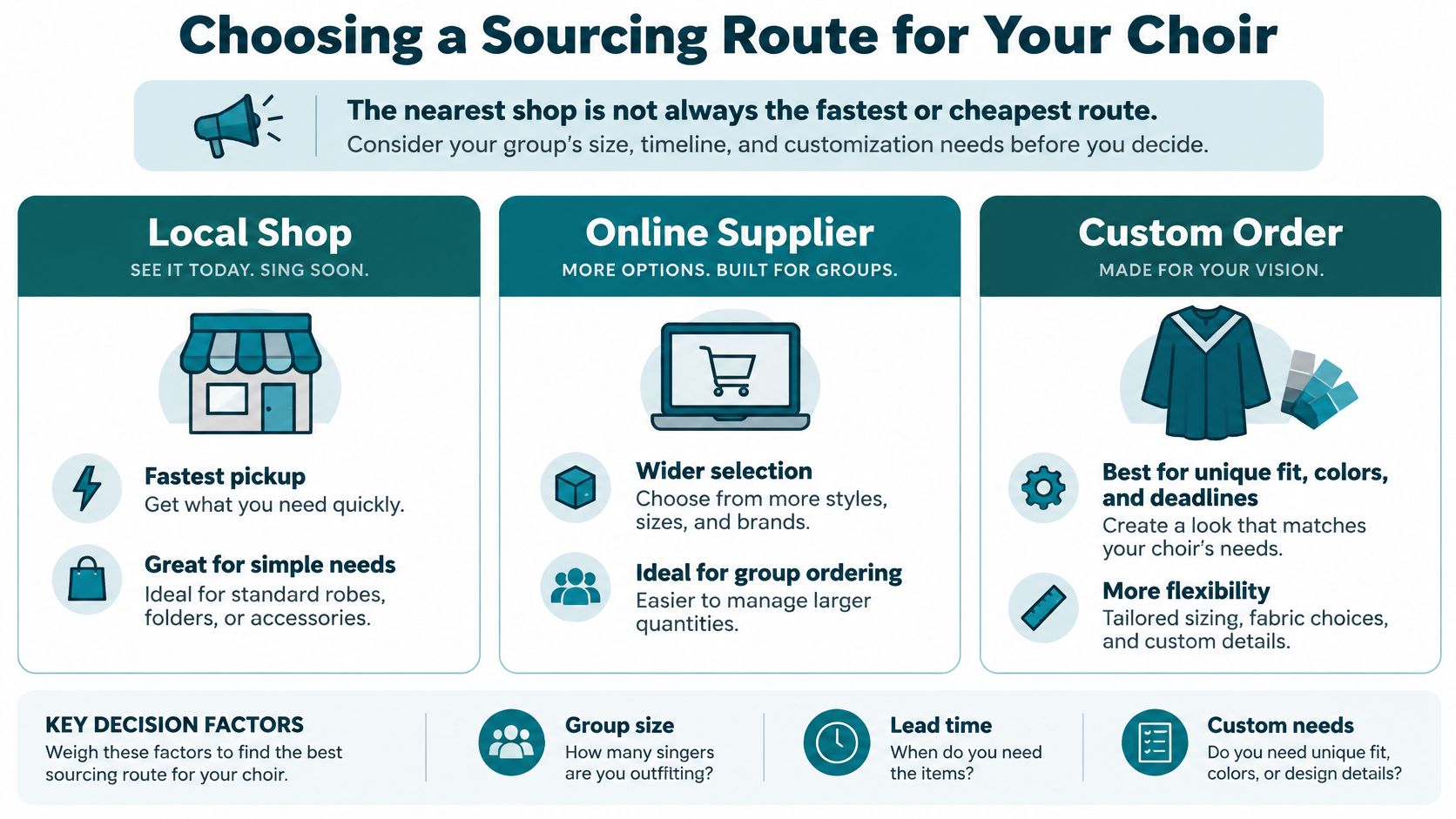
Match the route to group size, lead time, and custom needs before you compare unit price.
| Source | Best for | Lead time | Custom options | What to ask before ordering |
|---|---|---|---|---|
| Local church supply or uniform shop | Small choirs that want to try robes on | Stock-dependent | Usually standard colors only | Can you hold my size and color in stock? |
| Online wholesaler such as Clerkmans | Groups of ten or more, standard or custom robes | Ship or make date printed on the quote | Custom choral gowns, piping and stole options, custom quotes | Is a quote and mock-up available before I order? |
| Custom tailor or costume maker | Unusual fits or one-off designs | Weeks counted from fabric order through fittings | Full custom work | How many weeks for fabric sourcing and fitting? |
| Rented or shared robes from another choir | One-off performances or guest singers | The lender's written pickup date | None | Are cleaning and size records kept for each robe? |
What each route actually does
A local church supply or uniform shop wins when fewer than twenty singers need to try a standard robe on this week. You see drape and zipper pull in person. You lose range. If your color or a tall size is missing, do not wait on a reorder that may never come.
An online wholesaler fits a group of ten or more that needs one look. We carry church products that include choir robes, cassocks, stoles, baptism robes, clergy shirts, vestments, chasubles, albs, communion altar linens, and paraments, and custom choral gowns can be quoted with a mock-up before production. Ask for that quote in writing, then test one sample under your own lights.
A custom tailor is the right call for a singer who cannot use a standard block, not for a routine set of navy robes. Get the week count for fabric and fittings before you book the date.
Rented or shared robes cover a guest singer or a single concert. They fail when nobody can say which robe was cleaned, or which size is which.
Send fitting dates and size requests through the same channel you already use to manage congregation email updates, so singers do not hear about the order from a hallway conversation.
Start here: Under twenty singers who need a fitting, begin at a local shop and fill size or color gaps online. Twenty or more who need a matched custom set, request a quote and mock-up, then view a sample in the venue. Several ensembles sharing stock, standardize measurements, color records, and cleaning for every group.
Inclusive Fit for Mixed-Age and Mixed-Ability Choirs
Uniform does not mean identical. A robe that reads as one block from the pew can still stop someone from singing if it is heavy, hot, tight, or impossible to put on over the clothes they already wear.
A 2025 study of Liverpool Cathedral's choral ecosystem found that educational outreach attracted a younger and more socioeconomically diverse audience, including 36% of surveyed school-program participants reporting no religion. Participation is not the same thing as religious affiliation. A school or community choir should not assume faith-based dress, or one adult pattern, will fit the room.
An access checklist that still looks matched
- Hem clearance: The hem clears wheelchair wheels, footrests, and the front edge of a step. A shorter hem on every singer is more even than one singer tripping.
- Closures: Open-front styles or adjustable closures help limited arm mobility. A back zip that needs a second person is a barrier, not a detail.
- Weight and seams: Lighter cloth and seams that do not rub matter for heat and sensory sensitivity.
- What is worn underneath: Leave room for religious dress, a pregnancy, or everyday clothes. Do not ask a singer to change who they are to match a yoke.
Children's and adult blocks are proportioned differently, so measure children on a children's chart, not a shrunk adult size. Children's choir robes are the right starting rack for that group. A school that also robes a ceremony can look at a Matte Navy Blue Middle School Gown in matte, non-see-through tricot, with a darted yoke, front pleats, reinforced stitching, and a navy zipper, offered in multiple sizes and packed one gown per bag.
Sew or tag the size inside the robe. An outside marker singles people out. Before you order, ask whether sleeves and hems can be altered, and who does the work.
At the fitting, ask three things only. Can we try one sample before the group order? Which closures adjust? What is the fabric weight?
Measuring Singers for a Correct Fit
A robe size is a set of measurements on one person. It is not the singer's age, and it is not the size printed on last year's order form. Guessing from a previous list is how you end up with a front zip that will not close and a hem that pools on the chancel step.
| Measurement | How to take it | What it decides |
|---|---|---|
| Height | Stand straight, shoes off, record to the nearest centimeter or half inch | Gown length and hem clearance on steps |
| Chest | Measure around the fullest point with arms relaxed at the sides | Body width and whether the front zip closes comfortably |
| Shoulder width | Measure edge to edge across the back, from shoulder point to shoulder point | Yoke fit and how the robe hangs on the shoulders |
| Sleeve length | Measure from shoulder point to wrist with the arm slightly bent | Sleeve length and cuff position when the arms are raised |
| Neck | Measure around the base of the neck where a collar sits | Collar fit on mandarin or high-neck styles |
One sheet, one unit
Measure every singer standing, relaxed, shoes off. Write every figure in the same unit on one shared sheet. If someone lands between two size bands, flag the name. I would take the larger size when the chest or shoulder is the tight point, and alter the hem rather than squeeze the zip.
Height sets whether the hem clears steps or drags. Chest and shoulder decide whether the front closes without strain across the yoke. Sleeve length decides where the cuff sits once the arms go up to hold music. Neck only matters on a mandarin or high collar. Skip it on an open V and you have not lost anything.
Custom orders are available for products such as stoles, diploma covers, and gowns, and a quote and mock-up design are provided before production. Finish the sheet before that request goes out. A mock-up built on guessed numbers wastes the week you needed for sewing.
The fitting check before anyone leaves
Put the robe on over everyday clothes. Raise both arms. Sit, then stand. Confirm sleeve, hem, and zip before the robe leaves the room. If the zip gaps when the singer sits, the chest measurement was taken too tight, or the size band is wrong. Fix it now, not on the morning of the service.
Choosing Colors That Match Your Voice Sections
Color can mark musical structure, not just taste. In 1952, employees of Herman Miller formed a company-sponsored mixed chorus, and Charles and Ray Eames were commissioned to design the robes. As The Henry Ford's account of the Eames choral robes records, the garments used color to identify soprano, alto, tenor, and bass, with lighter-to-darker shades for higher-to-lower ranges.

The chorus was disbanded by 1960. The robes went to the Hope College Chapel Choir, stayed in use for more than 44 years, and were retired in 2004. Hope later commissioned replicas because the design had become distinctive. A shade system can outlast the original group. It can also fail if the back row cannot tell the shades apart.
You have two workable choices. One base color keeps the choir visually one body. A controlled shade range marks sections, but those shades must still read from the last pew. Our standard robes include navy, royal blue, maroon, and black. Piping and choir stoles can mark section leaders without a second full gown color.
Dark cloth often turns black under stage light. A swatch that matches in daylight can disappear on the platform. Watch a short walk-through of how a set reads in a real room before you trust a catalog chip.
- Pick one base color for the whole choir.
- Decide whether section identity is needed.
- Match that color to banners, paraments, or existing church colors.
- Order one sample and view it under the venue lights before the full order.
Color is a visual identity decision. Test it. Do not settle it from a swatch on a desk.
Fabric, Laundering and Colorfastness Explained
Treat color retention and laundering as purchasing specs. Group robes are washed over and over, and they have to match across the whole set for the season.
Textile research in the Egyptian Journal of Chemistry reports effective laundry colorfastness in cotton, nylon, and polyester when those fibers are appropriately dyed and laundered. Polyester blends are also studied for colorfastness along with physical and UV-resistance properties, which matters under strong stage light and in transit.
| Fiber | In the wash | Check on the spec sheet | Where it suits a choir |
|---|---|---|---|
| Cotton | Breathes, can shrink and bleed if the dye is poor | Wash temperature and shrinkage note | Cooler rooms, less frequent washing |
| Nylon | Strong, can hold dye well when finished correctly | Colorfastness note and dry method | Robes that travel and get handled often |
| Polyester | Holds shape, can glaze or crease if dried too hot | Maximum dryer heat | Weekly-use sets that must stay matched |
| Polyester blend | Balances hand-feel with shape retention | Blend ratio plus UV note | Stages with hot lights and long hanging time |
The buying routine
- Ask the supplier for fiber content, wash temperature, drying method, and any colorfastness or care sheet.
- Wash one sample on the cycle you will use before you order the set.
- Look for dye bleed onto light collars, stoles, or surplices. Keep dark robes away from light pieces for the first few washes.
- After a high-heat dry, check seam distortion, pilling, and shrinkage. If the hem jumped, that heat is too high for the set.
Record lot numbers when the cartons arrive. A replacement from a later dye lot will show under the same lights that flatten everything else. If the choir also keeps wool outer layers for an outdoor procession, the same "one method for the whole set" rule is what care tips for plaid wool coats are built around. Do not invent a special cycle for the two robes that look dirtier. Wash the set together.
Fire Safety and Fit Checks for Performance Venues
Picture a choir processing onto a raised chancel by candlelight. The hem clears the floor in the fitting room, then catches the first step. Flowing cloth is a trip and ignition hazard, not only a style choice.
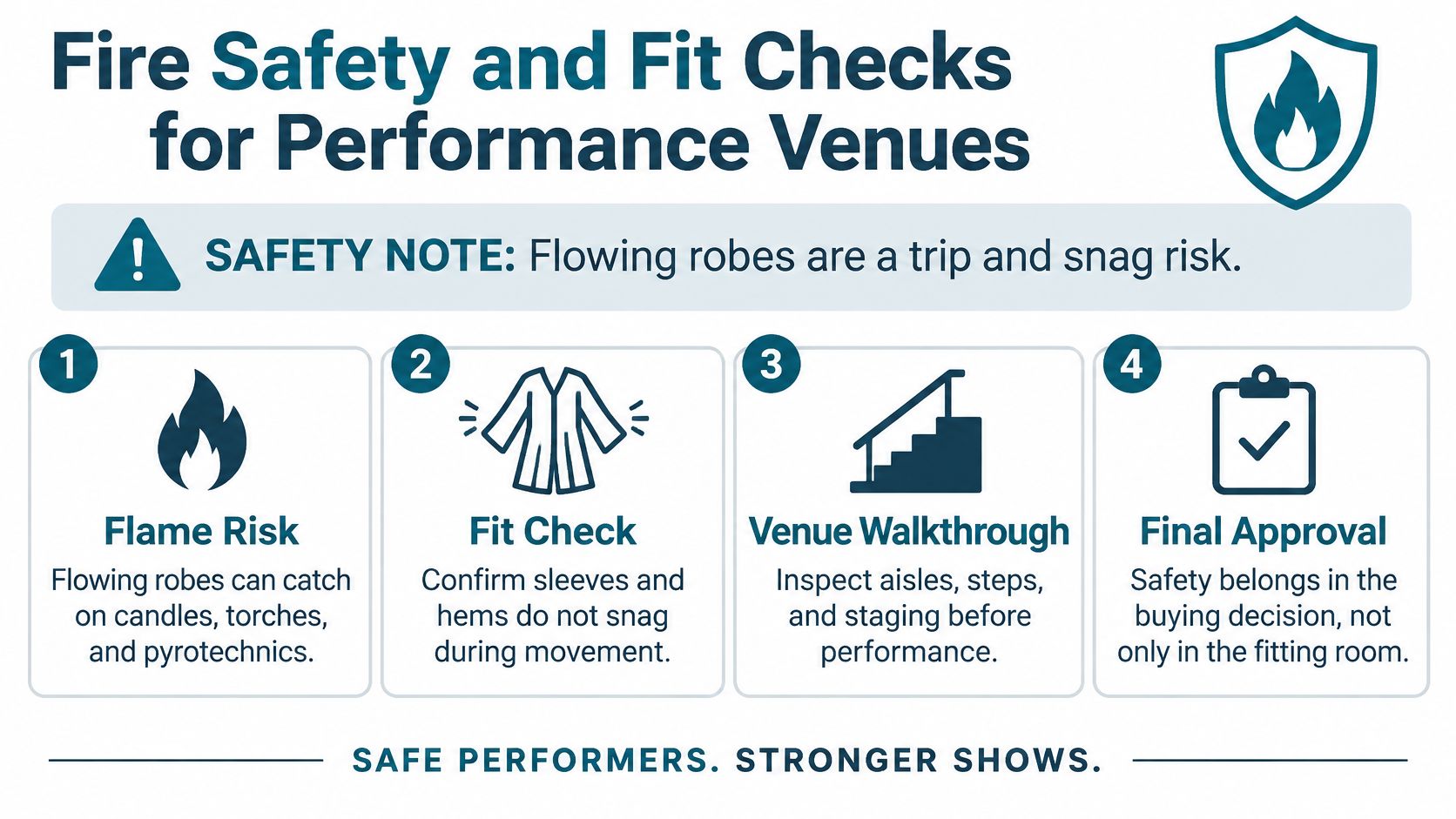
University performing-arts guidance recommends flame-resistant construction or a professionally applied flame-retardant treatment, reviewed by safety staff, when productions use candles, torches, pyrotechnics, or other open flame. University of California performing-arts costume guidance also points to Ontario live-performance practice, a practical 1-metre rule: costumes and other textiles within 1 metre of a flame effect should be flame-resistant or treated, and treatment may need renewal after laundering or dry cleaning. Ask about that renewal before you buy. A treatment that washes out is not a treatment.
Six checks before the order is final
- Paperwork: Request fiber composition, flame-resistance documentation, and care instructions.
- Labels that prove nothing: Do not treat a dark color, a heavy drape, or a "performance" label as compliance.
- Hem: At the length you will order, the hem does not drag.
- Sleeves: Sleeves do not catch on music stands when the arm is raised.
- Add-ons: Stoles and accessories cannot snag microphones, handrails, or instruments.
- Closures: Zippers and ties stay shut while the singer walks, sits, and stands.
Walk the actual route, not a carpeted hallway. Encore Academy's recital staging guide is a useful model for checking aisles, steps, and spacing before anyone is in costume. A matched silhouette is worth keeping. It is not worth a hem that catches a step or a treatment that fails after the first dry clean.
Pricing, Lead Times and Bulk Order Planning
Read both prices before you budget. The as-low-as figure is the lower quantity-based price shown for that robe. Confirm in writing which tier applies to the number you are ordering.
| Robe | List price | As-low-as price |
|---|---|---|
| Melody, Harmony, Corona or Delta Choir Robe (custom choral gown) | $99.95 | $79.96 |
| Deluxe Navy Blue, Royal Blue or Maroon Choir Robe | $89.95 | $71.96 |
| Deluxe Black Choir Robe | $69.95 | $55.96 |
On a custom choral gown, that gap is $19.99 per robe between list and the lower shown price. On the Deluxe Black robe it is $13.99. For a choir of twenty or more, ask which volume tier applies. Do not assume the lower figure until the quote names your quantity.
Build the calendar backward
Say the concert is ten weeks out. Subtract the production time stated on the written quote. Then subtract the shipping buffer the seller confirms. The date that remains is your order date. If that date is already past, you do not have a custom order. You have a stock order, a rental, or a later concert.
Rush timing is arranged by contacting customer service directly. Order a few extra robes in the sizes you are most likely to need for growth, late joiners, and replacements, and put them in the same budget. Lock the quantity and the size list first. Changing a custom order late adds delay.
Cost across seasons, not one invoice
Compare buying, renting, and sharing over several seasons, and include cleaning plus replacement per robe. The cheapest robe on a single invoice is often the expensive one if it cannot be altered or passed to another ensemble.
Keep one inventory sheet with the count of each size. Note whether sleeves and hems can be altered, and who does that work. Mend a seam or hem at the first fray. Store robes flat with the lot number still attached. Decide in advance whether a retired robe goes to another school, church, or community choir.
Use the sizing and color charts and the order forms on the site, and contact customer service when the question is rush timing or a volume tier.
We sell standard choir robes in several colors, custom choral gowns, children's robes, cassocks, and choir stoles, with list and quantity-based prices you can check before you commit. If you are choosing a route for a real ensemble, start with measurements and one sample, not the nearest pin. Visit Clerkmans to compare colors, request a quote, and line the order up with your concert date.