

Forget the universal color chart. That's the most popular advice about cords and stoles, and it's the advice most likely to get a graduate corrected in the lineup. A gold cord doesn't prove a grade point average everywhere, a blue stole doesn't name a major everywhere, and buying the right shade online doesn't give you permission to wear it. The issuer sets the meaning, the ceremony office sets the permission, and the shape of the item is only the starting point.
Read what you're holding first, then ask who issued it, then ask whether your school allows it in the procession. That order saves money, prevents accidental misrepresentation, and keeps required regalia, the cap, gown, and degree hood where required, distinct from optional recognition. If you keep those three questions separate, cords and stoles stop being confusing.
Table of Contents
- Cords and Stoles at a Glance
- Where the Customs Came From
- How to Wear Cords and Stoles Together
- Cord Colors That Only Your School Defines
- Honors Heritage and Service in Real Ceremonies
- Confirm Approval and Place Your Order
Cords and Stoles at a Glance
From the audience, the difference is visual before it's symbolic. An honor cord is a braided rope looped at the neck so both ends fall down the front of the gown. A graduation stole is a cloth sash laid over both shoulders so one wide panel hangs on each side of the chest. One looks like rope, the other looks like fabric, and naming that shape correctly prevents most ordering mistakes.
A graduate wearing several cords can look layered because ropes can twist together and sit side by side. A graduate wearing one stole looks simpler because the flat panels stay open and cover more of the gown front. Neither look tells you, by itself, who earned the higher honor. A campus may award its top distinction with a cord, a stole, a medal, or some combination, so don't rank students by how busy the front of the gown looks.
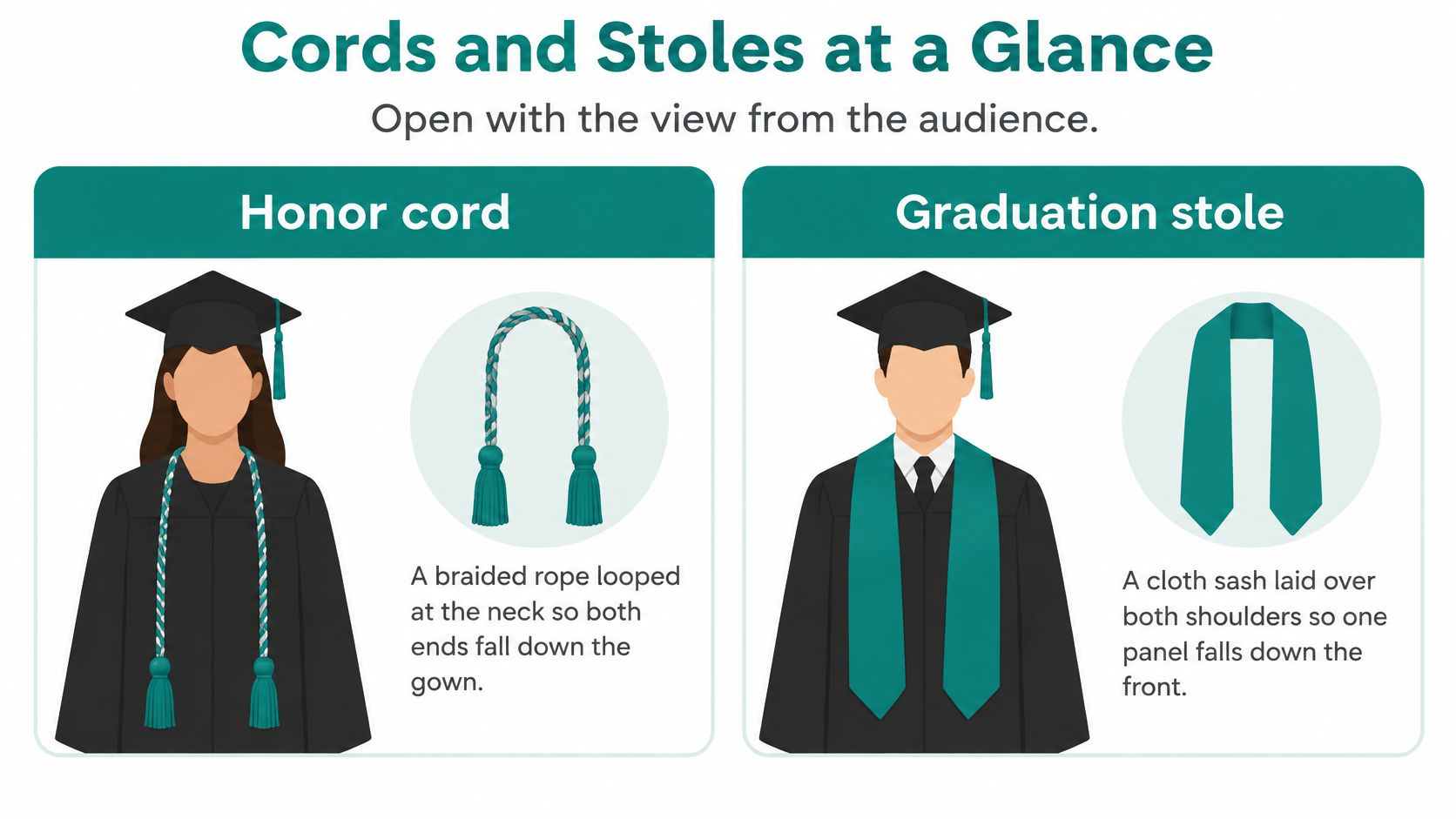
What Each Item Usually Announces
The familiar pictures are useful if you don't turn them into rules. A gold cord is the picture many people carry of an honor graduate. A wide stole is the picture many people carry of a club, cultural group, service organization, or society. Those associations are common, but a school can use a stole for academic honors and a cord for service, so the issuer matters more than the silhouette.
Neither piece replaces the cap and gown. Where a degree hood is required, the hood still marks the degree, and any approved cord or stole is an added sign on top of that foundation. If you're sorting a pile of regalia at home, lay the required pieces out first, then place cords and stoles in a second pile labeled by issuer. That small habit makes permission checks much easier.
If you're also planning the academic choices that lead to these ceremonies, you can explore subject selection insights as background reading, but your own commencement office remains the authority for what crosses the stage.
| Feature | Honor cord | Graduation stole |
|---|---|---|
| Form | Braided rope, often a single cord or a twisted pair | Wide fabric sash with two front panels |
| How it is worn | Looped once around the neck, ends down the front | Draped over both shoulders, one panel on each side |
| Usual message | Latin honors, honor societies, military or veteran status | Honors, societies, heritage, nationality, or service |
| Who sets the meaning | The school or the issuing organization | The school, organization, or the wearer's heritage group |
| With other regalia | Added over gown and hood; never a substitute for them | Added over gown and hood; panels should not hide hood colors |
| Approval | Ceremony office or the group that awards it | Same, and cultural stoles often need pre-approval |
Name the Object Before You Check the Color
Start every conversation with a precise noun. Say, "I have a single braided cord from this society," or, "I have a fabric stole from this program," rather than, "I have the gold thing." Staff can answer faster, a supplier can quote the right construction, and you won't order a sash when the award specifies a rope.
Practical rule: Shape tells you how to wear it. The issuer tells you what it means. The ceremony office tells you whether you may wear it.
When you're browsing options after you've confirmed the form you need, compare the construction in a dedicated graduation stoles collection against the description your school gave you. Look at panel shape, drape, and how the neckline sits, not just the color swatch. If the written approval says cord and the product page shows a flat sash, stop, even if the shade looks identical in a photo.
Families sometimes ask whether a plain gown means a student earned nothing. It doesn't. Some schools limit adornments sharply, some distribute cords at check-in, and some recognize honors in the program rather than on the gown. A simple front can reflect policy, not achievement.
Where the Customs Came From
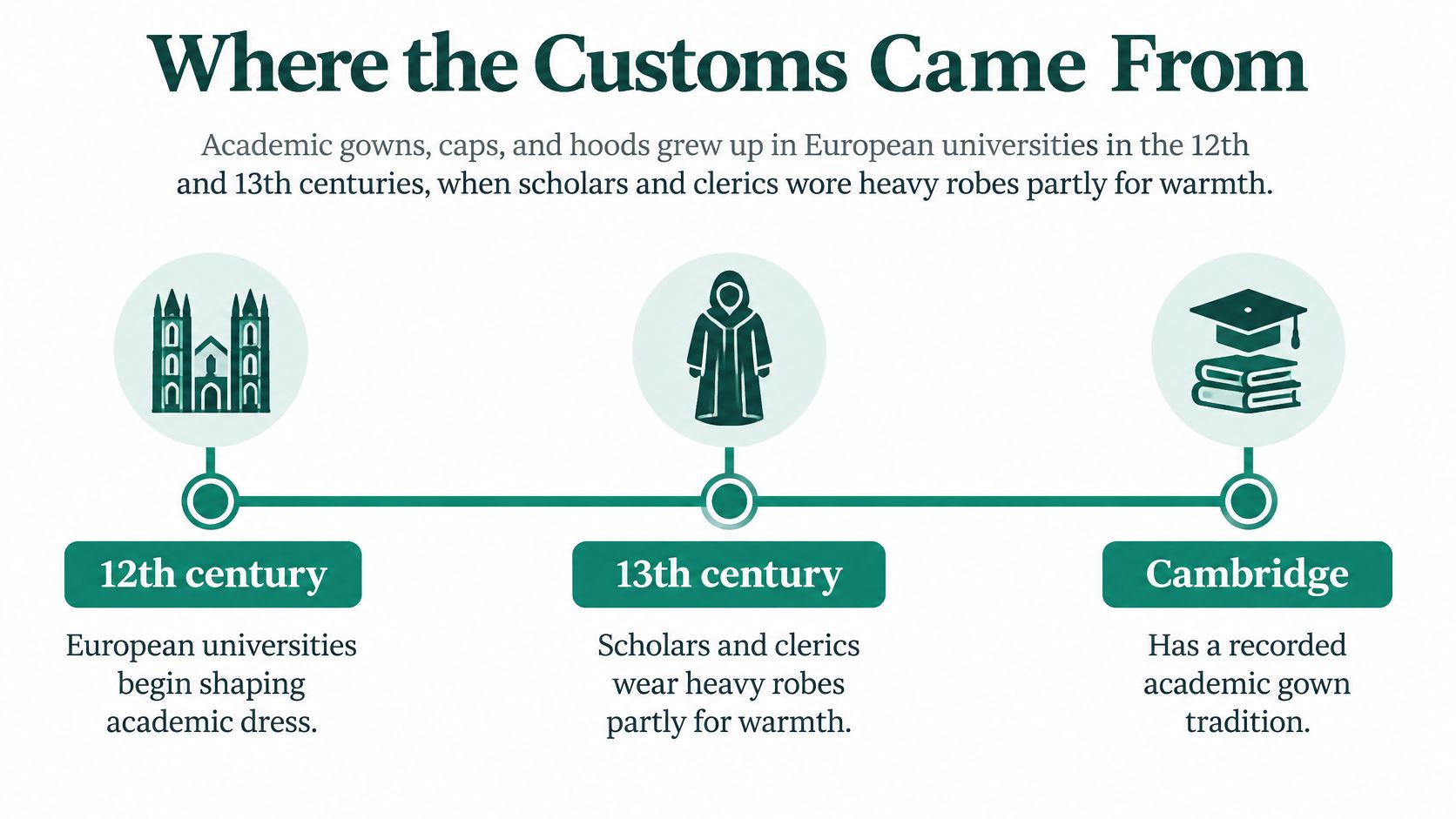
Academic dress began as practical clothing for scholars, not as a costume designed for photographs. Gowns, caps, and hoods emerged in medieval European universities, where scholars and clerics wore heavy robes partly to stay warm in unheated buildings, as Creighton University's account of graduation attire explains. The University of Cambridge has a recorded appearance of an academic gown dating to 1284.
The timeline below places the early robes before the later American effort to standardize academic dress.
In 1895, American institutions adopted an intercollegiate code governing degree-related designs and colors. That shared framework helped make gowns and hoods recognizable across campuses, while honor cords developed as a more local visual language. The Creighton account describes one university's system: gold cords mark summa cum laude, blue marks magna cum laude, and silver marks cum laude. Separate cords represent military service and veteran status.
Stoles have a different history from the older gown tradition. The video below offers another view of how commencement attire developed.
That history explains why cords and stoles do not have a universal color key. Gowns and hoods follow a more shared academic code; cords and stoles often identify honors, affiliations, heritage, or service according to local practice. A color alone cannot prove what an item represents. Check your campus's lookup and ceremony rules to learn both what it signifies and whether you may wear it.
How to Wear Cords and Stoles Together
Dress in layers, from the required base outward. If you reverse the order, panels bunch at the neck, cords disappear under fabric, and a hood can end up trapped where its colors can't be seen. The sequence below gives each piece one position and one reason.
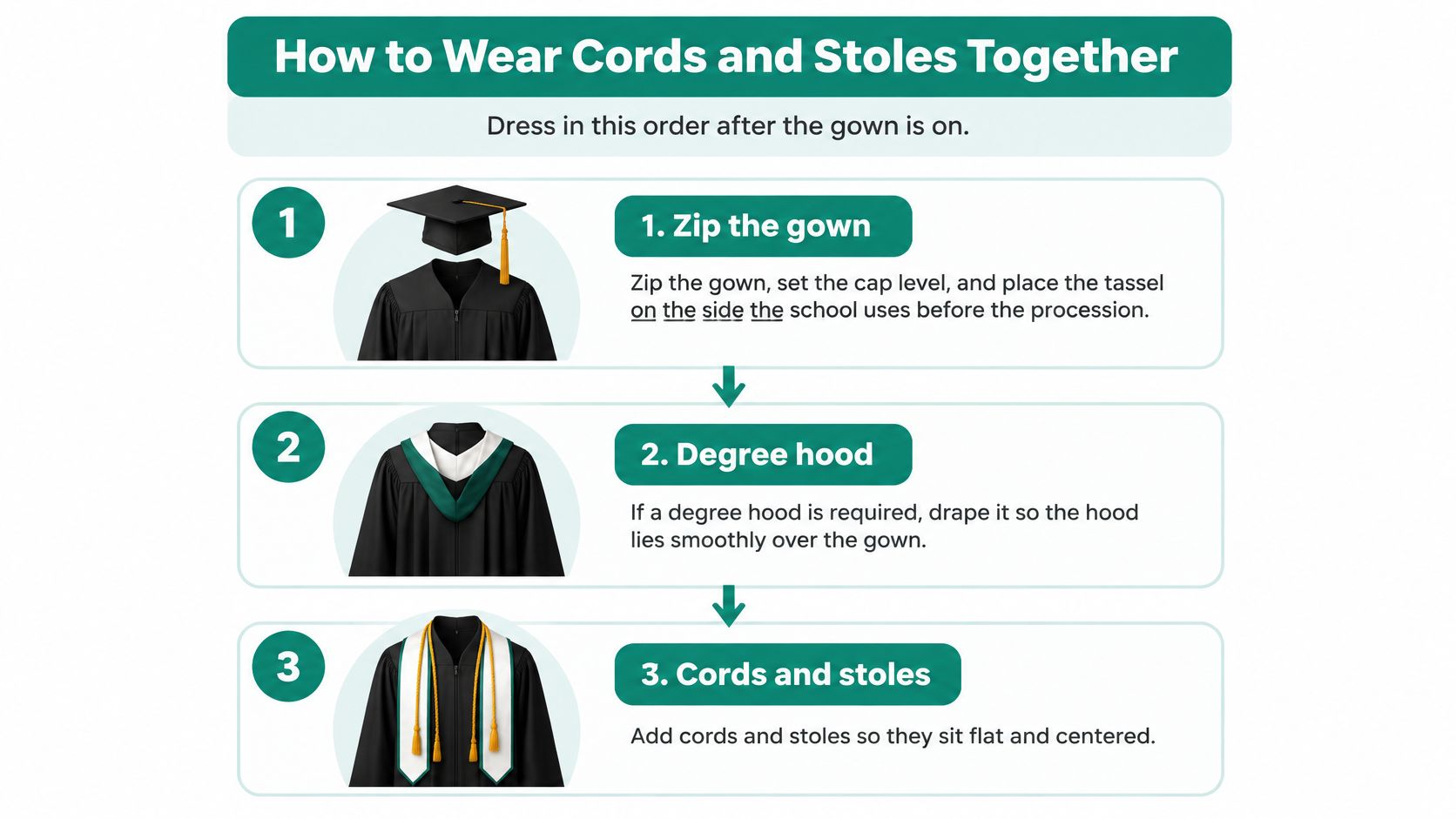
Build the Base First
- Zip the gown fully: Set the cap level and place the tassel on the side your school uses before the procession. A closed, straight gown gives every later layer a flat surface.
- Add the degree hood if required: Drape it so the velvet shows outward and the lining is visible where your school's diagram shows it. Keep the front arrangement clear enough that the hood remains the degree sign, not a background for accessories.
Don't pin anything yet. Pins can pull fabric, shift during the walk, and create a sharp point under a panel. Use only fasteners your ceremony office allows, and test them while you're still at home.
Add the Stole, Then the Cords
- Lay the stole across both shoulders: Center the neckline so it lies flat, then even the two front panels. If one panel is longer, slide the fabric gently at the back of the neck rather than tugging one side down, which twists the other panel.
- Loop each cord once at the center of the neck: Let both ends fall to about the same length. Place cords over the stole only when your ceremony diagram shows both together in that order, because layering is a policy choice as well as a styling choice.
- Check the approved combination: If the office allows a cord and a stole together, keep ropes visible against the panels for photos. If it doesn't, wear only the approved item in the ceremony and save the other for pictures afterward.
Don't solve a permission problem with clever layering. Hiding an unapproved item under a stole doesn't make it approved.
Finish With a Movement Check
- Place a medal only where the diagram places it: A medal ribbon competes for the same neck space as cords and stoles. Skip decorative pins unless the office allows them, since they can catch on a cord when you sit or stand.
- Sit, stand, and walk a few steps: Turn your head, lift your arms as if receiving a diploma cover, and check that nothing slides under an arm or covers a name card you must hand to a reader.
End in front of a mirror at audience distance, not inches away. Can you still see the hood colors if you're wearing a hood? Do the stole panels frame the center instead of crossing it? Do cord ends hang as pairs rather than tangling into one rope? If a layer needs constant holding, it isn't positioned correctly.
A common confusion is whether cords go under or over a stole for every school. There's no safe universal answer because some diagrams prioritize the stole's lettering and others prioritize a Latin honor cord. Follow your campus diagram over a social media photo from another institution. When no diagram exists, ask before the ceremony and bring the answer in writing.
Cord Colors That Only Your School Defines
A gold cord can mark Latin honors at one campus and a different award at another. Color has no universal key, so use your school's policy to identify what a cord represents and whether it is approved for the ceremony.
The University of Memphis cord and stole policy defines cords as single ropes worn over the robe and assigns white, crimson, and gold to undergraduate GPA bands of 3.25 to 3.49, 3.50 to 3.79, and 3.80 to 4.00, respectively. Utah State University also assigns colors to Latin honors, with its GPA thresholds listed in the university's Latin honors policy: 3.95 to 4.00 for gold, 3.80 to 3.94 for silver, and 3.50 to 3.79 for navy.
The comparison shows why a shade alone cannot identify an honor. Gold marks the highest band in both examples, but the GPA ranges differ. Silver marks a Latin honor at Utah State, while Memphis uses crimson for its middle distinction. Other campuses may assign cords to service or veterans. Copying a color from another school's chart could give the wrong message.
| Campus or source | Color | GPA or honor | What it marks |
|---|---|---|---|
| University of Memphis | White | 3.25 to 3.49 | Lower undergraduate distinction |
| University of Memphis | Crimson | 3.50 to 3.79 | Middle undergraduate distinction |
| University of Memphis | Gold | 3.80 to 4.00 | Highest undergraduate distinction |
| Utah State University | Navy | 3.50 to 3.79 | Latin honors |
| Utah State University | Silver | 3.80 to 3.94 | Latin honors |
| Utah State University | Gold | 3.95 to 4.00 | Latin honors |
| Unnamed sample campus | Gold, blue, or silver | Summa, magna, or cum laude | Latin honors, plus separate service cords |
Write a Specification, Not a Shade Name
For a school or group order, specify the institution, award category, cord construction, and approved color code. “Gold honor cord” leaves key details open: it does not say whether the school requires a single rope or a twisted pair, which honor the cord represents, or whether another cord can be substituted. Matching colors do not make different awards interchangeable.
When reviewing products in a graduation honor cord collection, compare each option with the written specification. If the award letter calls for a single rope, choose that construction rather than a double cord. If the school allows only institution-issued or pre-approved cords, confirm approval before ordering.
The gown also affects how the cord hangs and reads. Clerkmans' Deluxe Masters Graduation Gown is a master's gown option. Check that the cord is visible against the gown and does not obscure its front or any other regalia.
A color chart from another campus can suggest what to ask about. Your school's rules determine what the color means and whether you may wear it.
If your GPA is near a cutoff, ask which grades count, whether the school rounds, and when the final eligibility list is issued. The registrar's determination, not an unofficial calculation, establishes the award.
Honors Heritage and Service in Real Ceremonies
A stole's meaning depends on who issues it and where it is worn. Britannica's entry on the stole describes its history as a liturgical garment and notes that a nonliturgical version later became part of commencement attire. In academic ceremonies, a stole is generally a fabric sash worn from the shoulders down the front of the gown. Similar draping does not give every stole the same meaning.
Choir and clergy stoles belong to religious settings, where their use follows different customs. A commencement sash, in turn, does not automatically belong in a worship service. The ceremony and its rules shape how the garment is understood.
One Ceremony, Several Different Messages
Consider a hypothetical procession. One graduate wears a pewter-colored stole because her college assigns that color to students who complete Honors College requirements. The college's policy, not the shade of pewter, defines what the stole represents.
Behind her, a graduate wears a black-and-gold stole associated with a McNair Scholars program. A third graduate wears a military or veteran stole. These garments point to different experiences, so color alone cannot explain any of them.
| Example | Possible meaning |
|---|---|
| Pewter stole | An Honors College designation, as defined by that college |
| Black-and-gold stole | Participation in a research program |
| Military or veteran stole | Military or veteran service |
| Kente stole | Ghanaian heritage |
| Serape stole | Mexican heritage |
| Doctoral stole | Doctoral regalia or an academic honor, depending on the university |
Heritage Sits Beside the Degree
Kente and serape fabrics can express Ghanaian or Mexican heritage. A graduate choosing a cultural stole can check whether the commencement office permits it and, if needed, ask how the ceremony prefers it to be worn. That gives the wearer a way to honor family or community while respecting the event's rules.
Service recognition also depends on the wearer and the school's policy. A military and veteran graduation stole is one way service can be represented; some schools use cords instead. Wear a service item only when its use fits the school's rules and the wearer's own connection to that recognition.
Ask who the garment represents: a college, a research program, a service community, a family, or a faith community. That context helps others read it appropriately.
Some universities include stoles in doctoral regalia or use them for academic honors. Check the ceremony program and any instructions from the issuing office, especially if the garment's purpose is unclear.
Confirm Approval and Place Your Order
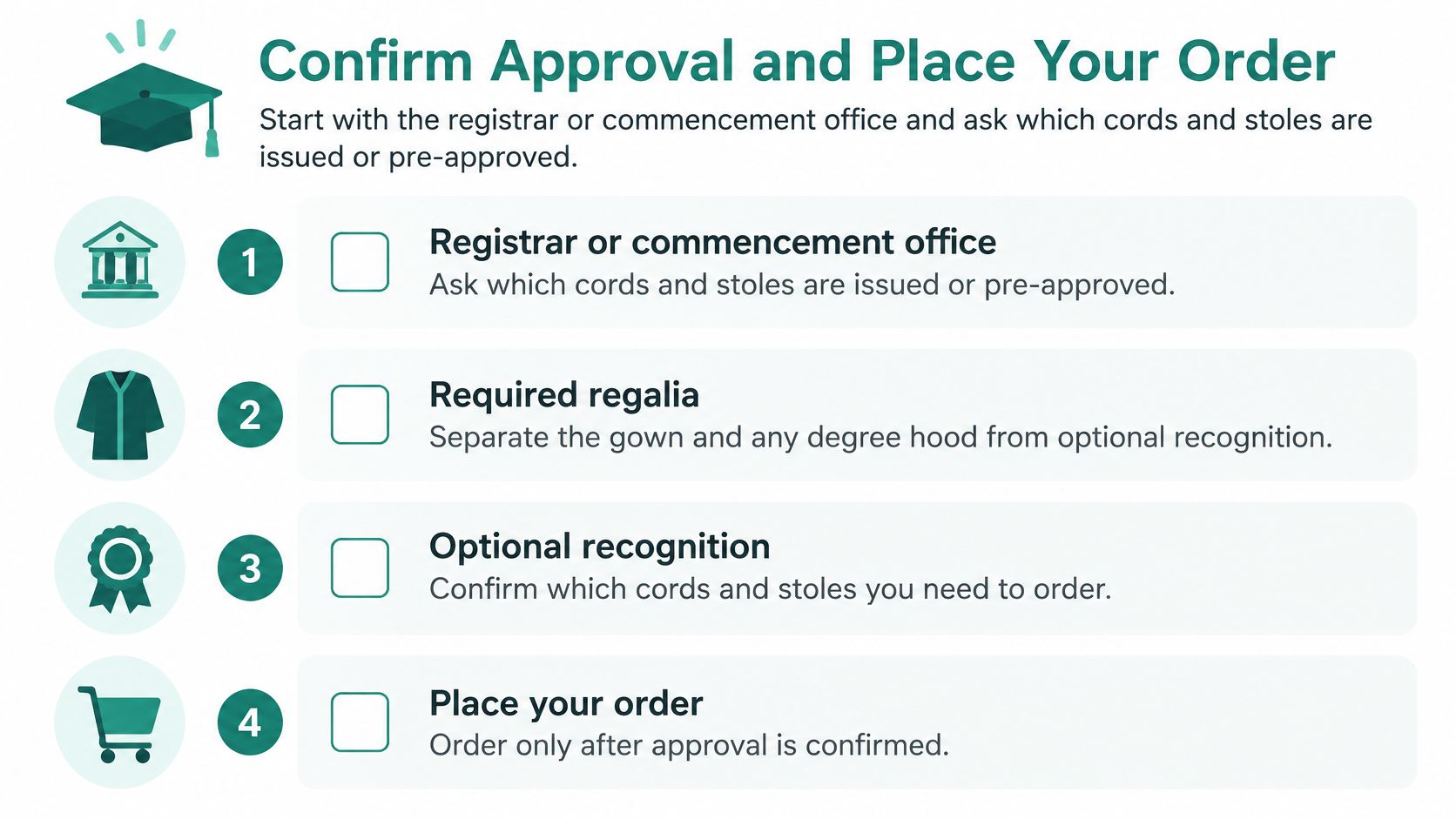
Start with permission, not a shopping cart. The question isn't, "Does this color prove my honor?" A purchased color can't establish GPA, rank, membership, or eligibility. Thomas Edison State University describes cords generally as recognition of an achievement or award in its honor cords guidance, while Kansas State assigns specific cord combinations to GPA-based honors and requires approval for organization-related cords and stoles. The contrast is the lesson. One page gives a general description, another gives a campus rule, and only your campus rule governs your walk.
Run the Permission Check
- Contact the registrar or commencement office: Ask which cords and stoles are officially issued and which outside items are pre-approved. Get the answer tied to your name or organization, not a general statement that accessories are "usually fine."
- Separate required from optional: List the cap, gown, tassel, and any degree hood as required regalia. List cords and stoles separately as recognition accessories, each with its issuer beside it.
- Ask about sponsors and limits: Find out whether an organization cord needs a sponsor letter, how many items may be worn at once, and whether students must choose one adornment type.
- Check combinations explicitly: Ask whether a cultural stole may sit with a Latin honor cord, whether multiple society cords may be twisted together, and where a medal fits. Multi-organization graduates are the most likely to be stopped because each item may be legitimate alone but not approved as a stack.
- Confirm hood placement: Ask how cords and stoles may be worn with a degree hood so the velvet and lining stay visible from the front.
Keep the approval confirmation with your gown. If a marshal questions an item, a calm written answer helps more than explaining what a website said the color means. If you can't obtain approval, leave the item for photos after the ceremony rather than arguing in the processional line.
More color choices don't automatically improve a ceremony. Without policy labels, extra choices can increase confusion, accidental misrepresentation, and rejected attire.
Turn Approval Into an Accurate Order
Once approval is clear, write the order in the same language as the approval. Record whether it's a cord, a stole, or both, then add the exact color, construction, issuer, and any approved lettering or emblem. Add cords and stoles to a graduate's gown order only when the color matches the award named in writing. For a group, bundle only accessories the office has cleared for that group, and add a school name, crest, or year only when the approval covers that customization.
We can embroider a school logo or mascot on a gown or stole, and customers can have an institution's logo or crest embroidered on the regalia. That ability doesn't replace permission to use the mark. Send the approved wording and artwork with the request, then check the mock-up character by character. A misspelled society name can't be fixed by good intentions on ceremony morning.
Timing needs the same precision. All orders with in-stock stoles take 2 to 4 business days to process and ship out. All custom stoles and hoods take 2 to 3 weeks to process and produce, plus shipping time. Custom stoles have a minimum of 6 pieces, and all 6 must have exactly the same design. Count backward from the ceremony, then add time for the office to review a sample or mock-up and for you to try the full outfit once.
Clerkmans at clerkmans.com can quote a mock-up for custom work, which is useful when a school needs the same design across a cohort. Send the quantity, approved colors, lettering, and deadline in one message. If the design changes after approval, send the revised version back to the ceremony office before production. A supplier can manufacture what you specify, but the office decides what may be worn.
A Final Readiness Check
The night before, lay out the gown, cap, tassel, hood if required, each approved cord, each approved stole, and the approval note. Steam or press only as the garment care allows, and keep cords untangled in separate loops. Photograph your approved arrangement on your phone. If a panel shifts while you're lining up, the photo helps you rebuild it without guessing.
If an item arrives in the wrong construction or shade, don't substitute it. Contact the issuer and the ceremony office, explain the difference, and ask whether the replacement is acceptable. That question protects the meaning of honors for everyone in the room. It also protects you from wearing a sign you haven't earned, which is the central risk behind every tempting universal chart.
Once your commencement office confirms the exact cord or stole you're allowed to wear, visit Clerkmans to match that approval with graduation regalia, honor cords, stoles, caps, gowns, hoods, and related accessories in one place. Bring your item type, approved color, issuer, and customization details so you can order a set that fits your ceremony rules.