

You try on a borrowed robe before your first sitting. Standing in front of the mirror, it looks right: black, roomy, comfortably below the knee. Then you sit down, reach for a file, and discover that the hem rides up while the sleeves pull away from your wrists.
That's the difference between a robe that looks judicial and one that works at the bench. Choose judge robes as a coverage and neutrality specification first. Then work through fit, temperature, access, and care so the garment stays unobtrusive while you do your job.
Table of Contents
- Judge Robe Styles by Court and Cut
- Why the Black Robe Became the Default
- How to Size a Robe for the Bench
- Fabric Choices and Robe Care
- When Comfort or Belief Can Change the Robe
- Two Robes Measured Against the Same Checks
- Confirm the Court Rule Then Order the Robe
Judge Robe Styles by Court and Cut
Two judges can wear black robes and still be dressed for different courtrooms. A robe built for a US bench answers a different dress system from the one used in England and Wales, even when both garments descend from the same broad judicial tradition.
California provides a useful written baseline: California Rule of Court 10.505 requires a black robe extending down the front and back from the collar and shoulders to below the knees, with sleeves reaching the wrists and a style customary in US courts. That jurisdiction-specific rule gives a buyer concrete features to check.
Opacity, shoulder movement, and seated clearance belong on the purchasing checklist alongside those written requirements. Confirm the applicable rule with the clerk or court administrator before choosing a cut.
Match the court before the construction
Judge robe styles by court and cut
| Style | Color | Coverage | Construction | Where it belongs |
|---|---|---|---|---|
| Everyday US bench robe | Opaque black | Collar and shoulders to below the knee; sleeves to the wrists | Plain judicial silhouette in matte fabric | US trial and appellate courts, subject to local requirements |
| Coat-sleeve judicial robe | Black matte woven fabric | Below-knee body and wrist-reaching sleeves, fitted to the wearer | Shoulder and back fluting; coat-style sleeves; concealed front closure and pocket access on suitable models | US bench work when a fitted coat-style sleeve and generous shoulder cut are preferred |
| Lined yoke judicial robe | Black matte cloth | Court-compliant length with seated allowance specified during fitting | Structured yoke, lined sleeves, and closure and cuff details selected for the wearer | Custom US fitting when seated coverage and sleeve finish matter |
| England and Wales civil and family robe | Court-specified civil robe | Court-prescribed simplified dress | No wig or traditional neckwear in the applicable open proceedings | Applicable Court of Appeal and High Court civil and family hearings |
| England and Wales criminal robe | Red | Traditional criminal-court coverage | A year-round criminal set rather than separate seasonal sets | High Court criminal work |
The England and Wales rows are jurisdictional alternatives, and they follow a different court-dress system. A red ceremonial garment looks more formal than a plain black one, which is exactly why it tempts buyers into the wrong purchase.
The US construction rows describe practical choices within a familiar silhouette. A coat-style sleeve has a more defined shape around the arm. A lined-yoke construction adds structure across the upper body and another fabric layer inside the sleeves.
Read the details as working features
Shoulder fluting supplies fullness where the wearer reaches forward. A concealed closure keeps the front visually quiet, while a pocket slit can provide access to clothing underneath without opening the robe. Neither feature compensates for an incorrectly sized body.
Extra length carries its own cost. Excess fabric can catch under a chair or interfere with walking, especially when the wearer turns away from the bench.
Fitting priority: Choose the court-appropriate style first, then require that particular garment to work both standing and seated.
Ask for front, back, sleeve, and closure details rather than relying on a single catalog image. Once the style is settled, keep it fixed during measurement so you're comparing fit rather than continually changing the garment.
Why the Black Robe Became the Default
The black robe communicates office before personality. Its usefulness isn't that black is more dignified than another color. A shared garment lets people recognize the judge without first interpreting the wearer's clothes, taste, or status.
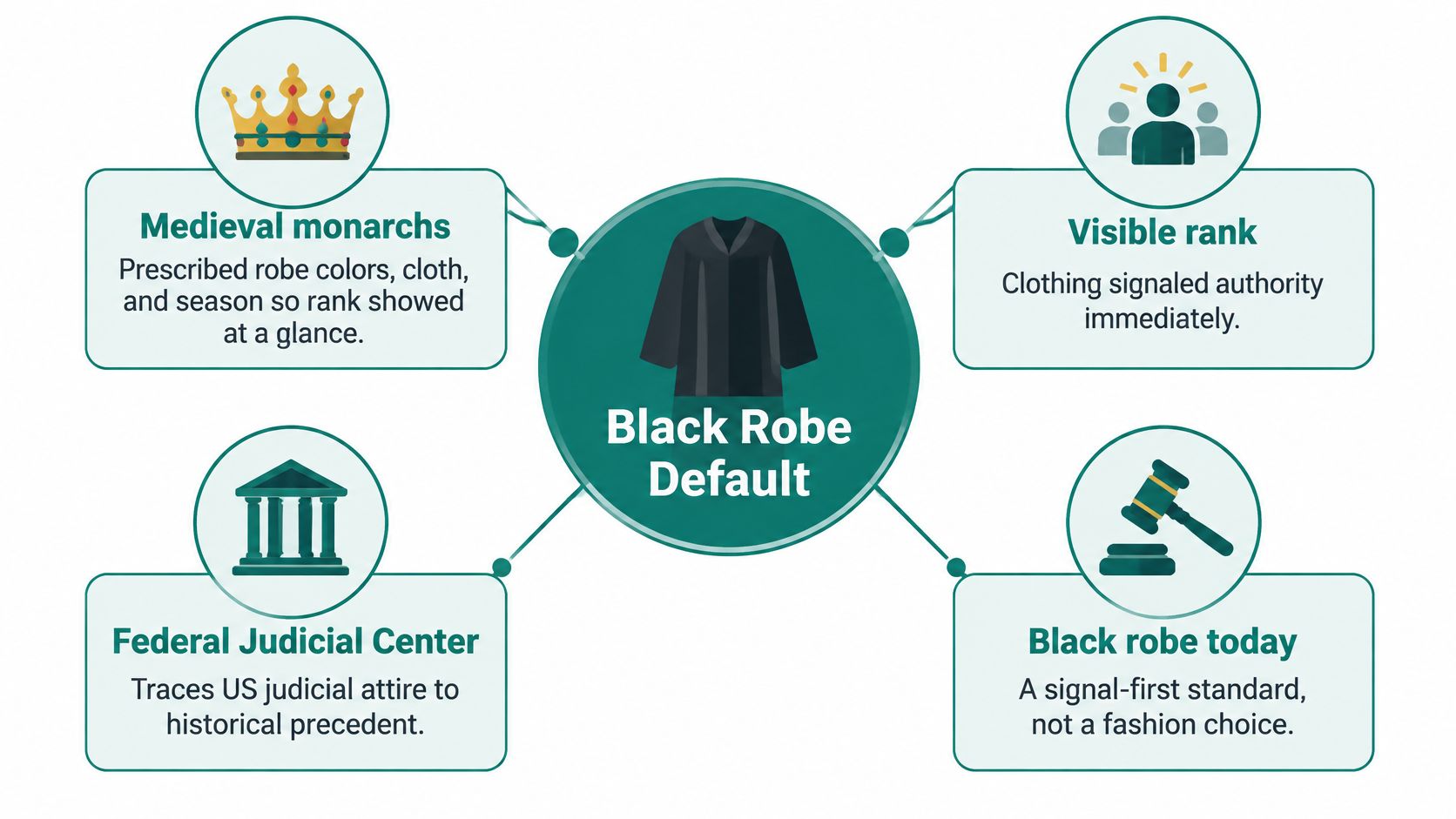
The Federal Judicial Center's judicial-attire overview traces judicial clothing to medieval European royal courts, where monarchs prescribed colors, materials, and seasonal styles. Clothing made authority and courtroom role visible. The modern plain robe retains that signaling function while removing much of the earlier display.
The relationship between historical dress and the present-day standard is summarized below.
A regulated tradition, not timeless black
English court dress wasn't always uniformly black. The Judiciary of England and Wales history describes the Judges' Rules of June 4, 1635, which specified existing robes by occasion and season, including black faced with light-colored fur in winter and violet or scarlet in summer; it also records modern reforms taking effect on October 1, 2008, introducing simplified civil dress and a single year-round red set for High Court criminal work.
American practice developed differently. According to the Illinois Courts history of the judicial robe, the Supreme Court's transition to plain black occurred sometime between 1796 and 1802, with the precise date and reason uncertain. Robe-wearing then spread through state court systems rather than through a national order.
That uncertainty matters. The familiar black robe is an institutional convention built over time, not a garment whose every detail can be explained by a single founding decision.
Use the gallery test
A plain surface helps keep attention on the judicial role. It doesn't prove impartiality, and wearing the right garment doesn't replace impartial conduct. It does avoid adding a competing personal message.
For purchasing decisions, use a simple gallery test: would someone watching the proceeding remember the outfit instead of the office?
- Color consistency: Compare fabric samples together so an unusually glossy or differently toned black doesn't distinguish an individual unnecessarily.
- Silhouette consistency: Keep the overall shoulder, sleeve, and front appearance coherent across a court cohort.
- Decorative restraint: Treat contrast piping, visible initials, and conspicuous trim as decisions requiring justification, not automatic upgrades.
A court can preserve recognizable authority while changing impractical clothing. The distinction is between an institution deliberately revising its dress and an individual turning a shared uniform into a signature look.
How to Size a Robe for the Bench
Measure for the work position, not just the fitting-room pose. Use a flexible dressmaker's tape, a mirror, a helper, and a chair close to the height and shape of the courtroom chair.
Wear the clothing you expect beneath the robe. A fitting over a thin shirt won't reveal the pressure created by a jacket, shoulder padding, or a thicker religious garment.
Take measurements without guessing the allowance
For tape placement and posture, Display Guru's body measurement tips for better fitting clothes provide a useful starting point. Use our size and color charts to interpret the relevant ordering fields, but distinguish body measurements from finished garment measurements.
- Record the body measurements. Measure height, chest or bust, shoulder-to-wrist sleeve length, and back length from the collar base toward the intended hem. Keep the tape level around the torso and don't pull it tight enough to compress clothing. Ask whether the maker wants actual body dimensions or dimensions with wearing ease already included.
- Test the shoulder allowance. Reach toward a document, bring your hands together, and lean forward as you would at the bench. The yoke shouldn't drag backward against the neck or pull the front closure sideways. A broader shoulder may need more fullness across the back rather than a longer sleeve.
- Check the bent arm. Bend the elbow and rest your forearm in a working position. The cuff should still reach the wrist without dragging across papers or catching a microphone control. If it retreats sharply, investigate sleeve length, armhole shape, and shoulder tightness together.
- Compare standing and seated hems. Check the front and back while standing, then sit naturally with your feet supported. Look for the front rising excessively, fabric pulling across the thighs, or the back becoming trapped beneath you. Specify the extra length through fitting rather than adding an arbitrary amount.
- Operate the closure and pocket access. Close the zipper completely, sit, and lean forward. It shouldn't bow open, dig into the torso, or force you to tug the front into place. Reach through a pocket slit to the clothing underneath without spreading the robe.
- Record each wearer separately. For a group order, don't substitute a shared size for individual measurements. Keep a separate record of body dimensions, intended garment length, sleeve needs, and approved accommodations.
Pass the movement test before approving the size
A standing photograph can hide a poor fit. Have the wearer sit, turn, rise, and walk before approving a sample or alteration.
For a mobility-device user, assess coverage across the lap and clearance around wheels, controls, and transfer points. Don't solve a lap-coverage problem by adding fabric where it could become entangled.
A robe passes fitting when the wearer can work without repeatedly pulling down the hem, pushing back the sleeves, or adjusting the shoulders.
Mark requested alterations on a fitting sheet. Record where the problem occurs and what movement causes it; “sleeve pulls when reaching for files” gives a fitter more useful information than “make it roomier.”
Fabric Choices and Robe Care
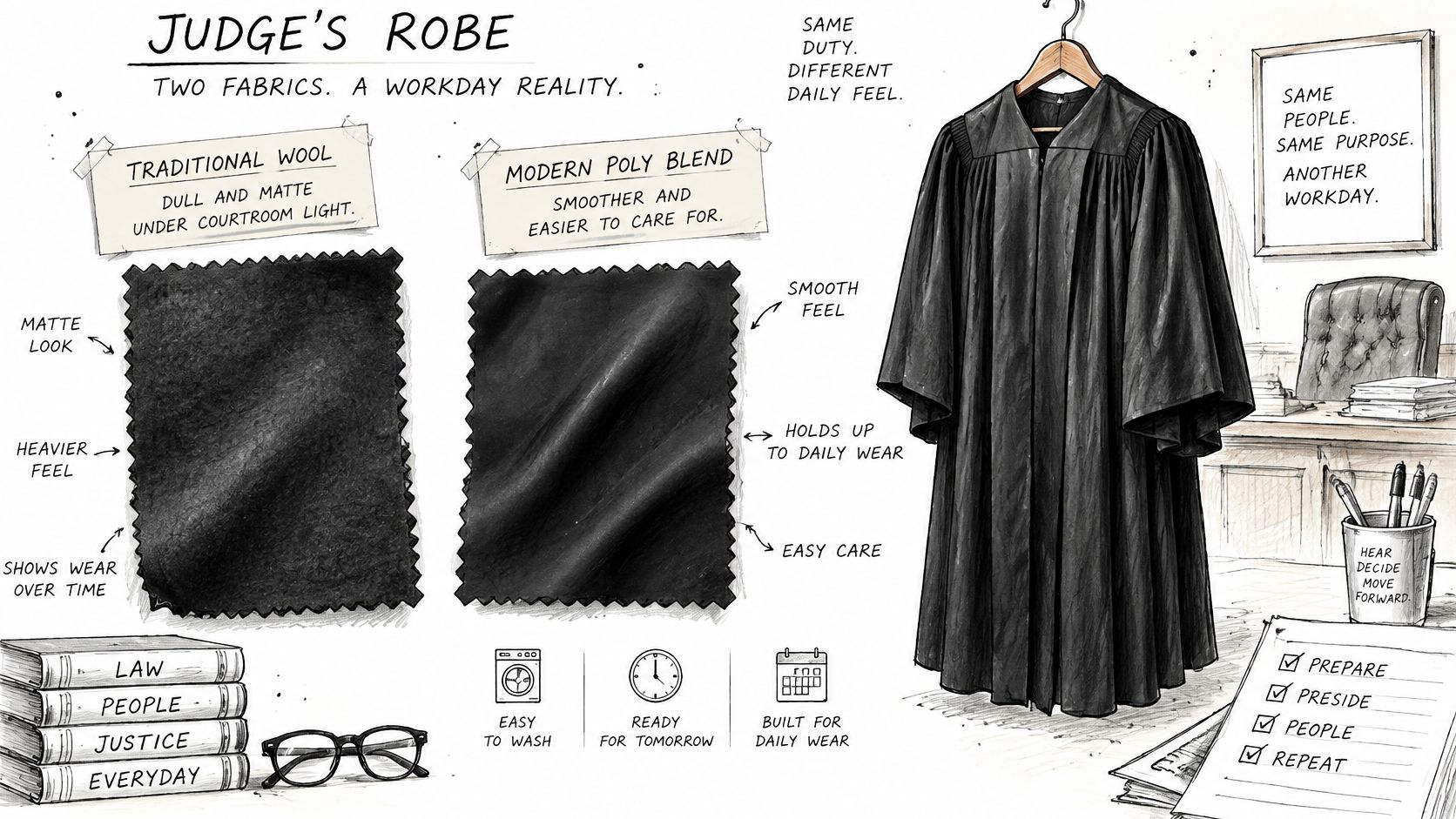
Choose cloth for the room and the docket, not for a luxury description. Matte fabric avoids distracting reflections, while adequate opacity prevents a light shirt or patterned jacket from showing through.
This illustration introduces the material choices, but a physical swatch and a wear test are more useful than appearance alone.
Match the cloth to the courtroom
A matte woven shell can provide a quiet surface without the reflective look of shiny suiting. Don't infer fiber content from a finish name: matte describes appearance, not whether the cloth is wool, polyester, or a blend.
Lined sleeves feel smoother over clothing and can make the garment easier to put on. They also add a layer around the arms, which may be welcome in a cool room and uncomfortable in a warm one.
Hold a sample over the shirt you normally wear, inspect it under strong light, and feel it against your forearm. If possible, try the complete robe with your usual clothing during an extended seated fitting. A lightweight shell can still feel hot when paired with substantial lining and a jacket.
Preserve the shape and finish
Use a short preservation routine rather than assuming every black robe can go through the same wash cycle.
- After wearing: Air the robe before enclosing it, then hang it on a broad hanger that supports the shoulders without crushing the fluting.
- Before transport: Close the zipper and let the fabric hang freely inside a judge robe garment bag, rather than packing it tightly around shoes or files.
- Before cleaning: Check the fiber and care labels, identify stains, and tell the cleaner about lining, detailed folds, cuffs, and embroidery.
- After cleaning: Inspect pocket-slit ends, zipper alignment, hem stitching, and the seat for damage or shine.
If the label calls for specialist cleaning, Tumble Laundry's professional dry cleaning for workwear is a relevant service reference. Confirm that the cleaner can handle the actual fabric and construction rather than treating the robe like an ordinary black coat.
Keep pressing heat conservative and appropriate to the care label. Don't press directly across embroidered details or flatten decorative folds with an iron.
Use the video as a supplementary visual reference, not a substitute for the garment's care instructions.
Repair or replacement becomes necessary when wear changes usable coverage, a failing zipper exposes the front, or permanent seat shine makes the finish conspicuous. A familiar style isn't a reason to keep a garment that no longer performs its job.
When Comfort or Belief Can Change the Robe
Neutrality doesn't require an uncomfortable garment. A robe that restricts movement, traps excessive heat, or causes sensory irritation encourages constant adjustment, which is distracting in its own right.
Start by separating usability changes from personal styling. Custom sizing, a smoother zipper, suitable sleeve clearance, and breathable matte cloth can improve use without changing the public-facing character of the garment.
Change access without claiming a new uniform
A mobility accommodation may require a differently shaped hem to maintain lap coverage safely. A religious head covering may need to work with the robe's neckline without creating pressure or restricting movement.
Those are not equivalent to choosing a conspicuous trim color just because you like it. Confirm proposed religious or mobility-related adaptations with the court before ordering, and document the approved specification.
For readers comparing ceremonial garments, our explanation of the difference between robes and vestments helps distinguish roles. Similar drape doesn't make garments intended for different offices interchangeable.
Decision boundary: Improve the wearer's ability to serve in the garment; don't assume that permission to improve fit includes permission to redesign its symbolism.
Consider the occasion as well as the garment
The Judicature analysis of the unadorned black robe describes plain dress as a signal to set personality aside and discusses New York ethics guidance that permitted a judge to wear a robe at a high-school graduation after considering whether doing so would lend judicial prestige to private interests.
That particular permission isn't blanket approval for civic appearances, commercial events, or promotional photographs. Off-bench use can raise questions that ordinary courtroom wear doesn't.
Before such an appearance, identify who is hosting, how the judge will be introduced, and whether publicity will suggest endorsement. Obtain applicable ethics guidance rather than relying on the event's friendly or educational purpose.
The buyer's boundary is straightforward: pursue fit and access within approved requirements, and change visible institutional symbolism only with the court's authorization.
Two Robes Measured Against the Same Checks
A coat-sleeve robe and a lined-yoke robe can both look correct in a catalog photo. Their usefulness separates once the wearer sits down, reaches for a file, and stays robed through a long calendar. Catalogs sell these patterns under different names, so treat the listed details as features to confirm in the order specification, never as proof that a garment fits without measurement.
Compare construction rather than prestige
Two robes against the same checks
| Check | Coat-sleeve robe | Lined-yoke robe |
|---|---|---|
| Fabric | Matte black woven cloth | Matte cloth with an added lining layer in the yoke |
| Shoulders and back | Follows the natural shoulder line | A shaped yoke holds a firmer line across the shoulders and upper back |
| Length | Confirm finished length against the seated fitting | Confirm finished length; the yoke's added weight can shift the drape |
| Sleeves | Coat-style cut built for shoulder reach | Confirm cuff bulk and weight once the arm rests on the bench |
| Closure and pocket | Confirm the front stays closed over the lap and any pocket opening stays discreet | Confirm the closure lies flat over the lined front while seated |
| Personal detail | A mark belongs on the robe only with court approval, and it stays discreet | Same standard: approval first, discretion always |
| Best fit | The familiar American silhouette with easy reach | A wearer who wants a more structured upper body and accepts added warmth |
For the coat-sleeve construction, concentrate on reaching. Have the wearer handle a file and rest a forearm on the bench so the fitting shows whether the shoulder translates into usable movement.
For the lined-yoke construction, concentrate on the interaction between length and the added yoke weight. The "lined" here refers to the shoulder and upper-back area, not the sleeves, and a generous body can drape well while that extra layer still feels warm across a long sitting.
Sit in both before deciding
Standing side by side, the two constructions can look interchangeable. The seat separates them. A coat-sleeve robe is the lighter garment and moves with the arm, but coverage depends on finished length: too short and the lap is exposed, too long and the hem bunches against the bench chair or catches when the judge rises. A lined yoke works like a jacket with a built-in interlining. It keeps a clean front across the lap, and it also keeps heat.
That warmth belongs in the coverage check, not off to the side. A robe that leaves its wearer pulling at cuffs or shrugging to cool off weakens the neutrality the garment exists to project, because attention drifts to the person inside it.
For a coordinated bench order, match the shared specification: the same cloth, silhouette family, and finish across every robe, with each judge's measurements applied individually. Use one approval standard for every wearer and let each judge's fit define the result.
Confirm the Court Rule Then Order the Robe
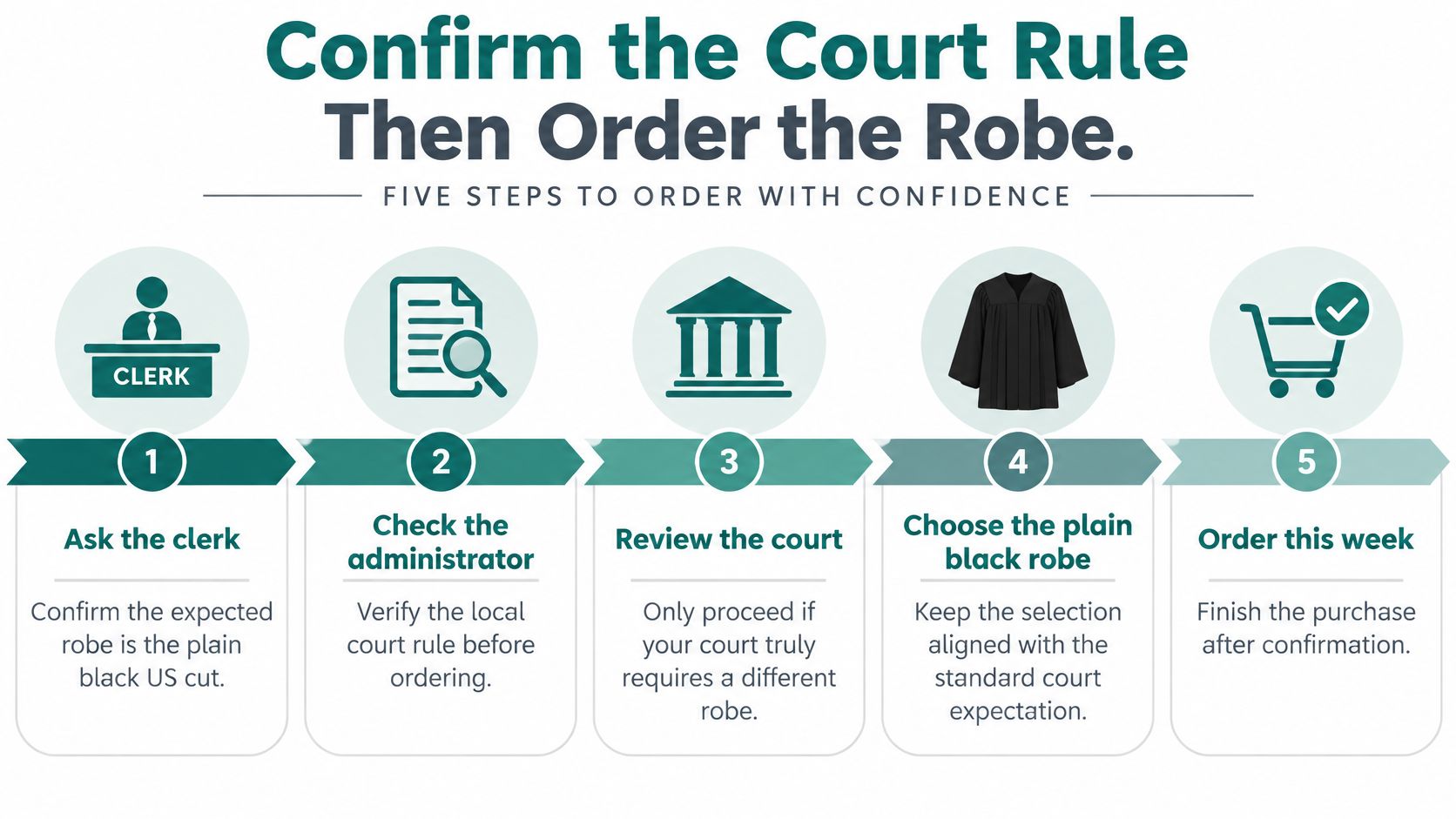
Ask the clerk or court administrator which rule governs the bench before authorizing a purchase. If the court follows a tradition other than the familiar American black robe, obtain the actual specification: a photograph can show color and length, but it cannot define coverage, closure, or acceptable ornament.
The confirmation sequence below keeps the purchase tied to court requirements.
Send a complete order specification
Give the seller the approved style, individual measurements, finished-length requirements, sleeve construction, closure preference, and pocket-access needs. Resolve accommodations before approving personalization.
- Attach the fitting record: Send the results from the earlier seated fitting so the order reflects the posture the robe must cover.
- Describe the cloth: Request the intended matte finish, opacity, and lining arrangement.
- Time the order: Obtain the current production and delivery estimate before committing to an investiture or first-sitting date.
- Price the fix: Ask how a fit problem will be handled before approving custom work.
If one judge needs an offset closure or a pocket opening as an accommodation, mark it as an approved exception on that person's order so an individual adjustment does not become the court's new default.
Keep a copy of the accepted order and compare the delivered garment against it before removing labels or arranging alterations. The check that matters is whether the robe still behaves like a coverage specification: opaque in court lighting, clean at the front when seated, and quiet enough that attention stays on the proceeding.
The purchasing order is simple: court requirements and coverage first, workable comfort second, ornament last. A successful robe lets the judge sit, move, and preside without making the garment part of the proceeding.
Our shop includes Judicial Robes alongside Shop By Graduation Type and Church Products, so choose the category intended for courtroom use. Visit Clerkmans to review judicial attire and sizing resources, with your court's approved specification and seated measurements ready before you order.